Stockholm International Comics Festival 2018

SELTA Chair Ruth Urbom is back from the Stockholm International Comics Festival at Kulturhuset with this report.

Not even the warm weekend sunshine could keep comics fans away from the cultural offerings at this year’s Stockholm International Comics Festival at Kulturhuset, the arts venue in the city centre, in early May. This year’s special focus was on Japanese comics, and there were guest artists and academics in attendance from several other countries including the Czech Republic, Finland, Poland and Spain. In addition to a packed schedule of panel talks and artist interviews – all free of charge to attend – the première of a documentary profiling a handful of Swedish comic artists rounded out the on-site programme. Those with an appetite for even more could explore a satellite programme of book launches, Japanese animated film screenings and gallery exhibitions around Stockholm.

Fans could stock up on books at Swedish comics publishers’ stands, and many author/artists were on hand to sign their works. Not content to simply sign the title page, many comic artists like to add a unique sketch or doodle to their dedication for an extra-special touch. Perhaps the buzziest atmosphere was to be found at the independent comics market, where indie artists could rent a table to showcase and sell their self-published comics and zines as well as postcards and other merch.

Many of today’s Swedish comic artists got their start at the Comic Art School or in dedicated courses at the University of Malmö in southern Sweden. In 2005 a group of independent comic artists formed Dotterbolaget, a collective dedicated to promoting their work and supporting new and emerging women artists.

Official festival image drawn by Åsa Ekström

Lars Norén – Print Room at the Coronet, London

SELTA member Kevin Halliwell reviews The Print Room at the Coronet’s welcome production of two short plays by Lars Norén. Act and Terminal 3 are directed by Anthony Nielson and translated from the Swedish by Marita Lindholm Gochman.

Act and Terminal 3

directed by Anthony Nielson, translated from the Swedish by Marita Lindholm Gochman. 1 – 30 June 2018

Lars Norén has a solid following across Europe and, to some extent, the United States, but his work has struggled to find the same exposure and recognition in the UK. The Print Room at the Coronet’s June 2018 production of two short Norén plays, Act and Terminal 3, is therefore particularly welcome.

Act centres on a power struggle between a hunger-striking terrorist and the doctor tasked with assessing her.  The piece was originally set in post-war Germany, with clear echoes of Ulrike Meinhof (the prisoner is simply named “M”), but for this production director Anthony Nielsen has updated the action to a dystopian America in the aftermath of some unspecified civil war.

The Coronet’s cavernous stage provides the perfect backdrop for Laura Hopkins’ post-apocalyptic set – a clutter of Coke cans, stockpiled toilet rolls, US and Confederate flags hanging forlornly, neon strip lights and a basic builder’s inspection lamp for physical examinations – all under the impassive gaze of a large crucifix.

In this desolate place, M and the physician G (Temi Wilkey and Barnaby Power) engage in a verbal combat in which each will try to destabilise the other, the prisoner often gaining the upper hand. How does she know so much about him and why do the facts keep shifting? Is what we are witnessing real or are we experiencing the hallucinations of M’s sleep-deprived mind?

What is undoubtedly real, however, is torture and the complicity of the State (then as now) in its execution. G’s homely Southern-states drawl belies a fierce determination as his assault on an already badly wounded arm provokes a terrible cry of pain that pierces the auditorium.

Following the interval, Terminal 3 opens with a giant screen that divides the space into two halves containing a young couple, He and She (Robert Stocks and Temi Wilkey) who are expecting their first child, and an older couple, Man and Woman (Barnaby Power and Hannah Young), who have come to identify their dead son. The space, which we are told is called “C” – or in a typical example of Norén’s comedic flippancy, “maybe ‘O’ with a bit missing” – thus doubles as a kind of waiting room for a maternity wing and a morgue respectively.
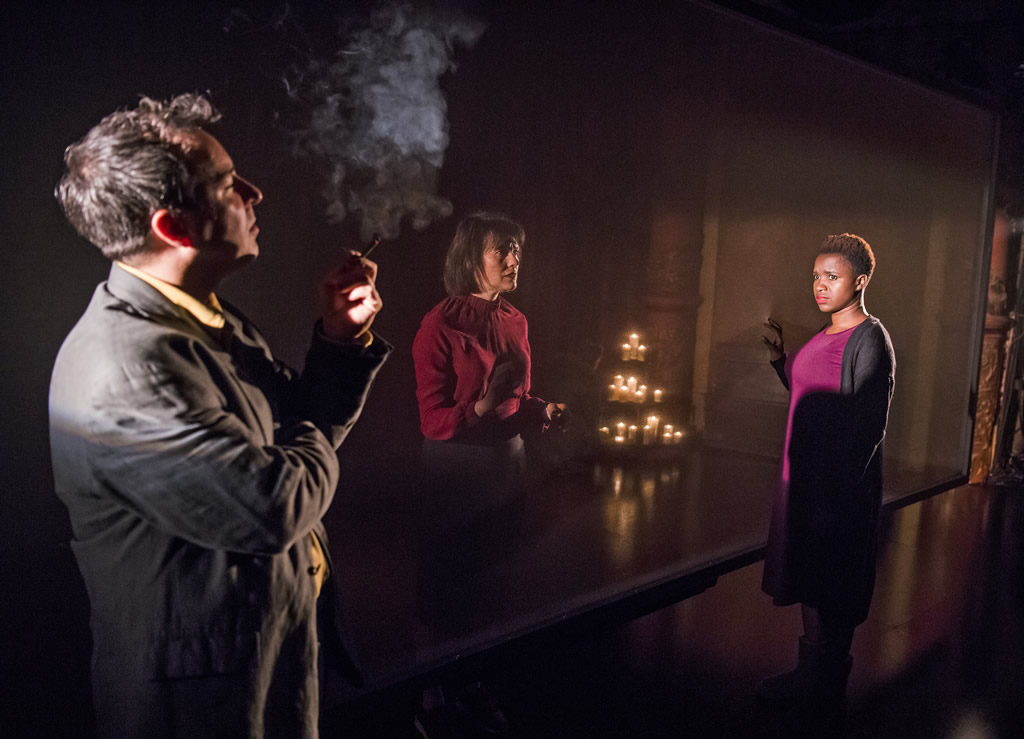

As their stories gradually overlap and intertwine, we become aware that this is one and the same couple, separated by 19 years of life and – mostly bitter – experience.

A leftover from the previous set is the ever-present crucifix, this time looming over a much sparser, more orderly environment. The dry ice and already wilting flowers strewn across the maternity half of the stage foreshadow the story unfolding on the other side, as does the dialogue between the clearly unhappy and ill-matched young couple. Morgue-side is more of a church-like environment, the Coronet’s late-baroque interior providing the perfect setting for church benches, flickering candles and the odd votive niche.

The piece is by turns awkward, darkly funny, moving and painful to watch as Norén presents us with some of his recurring themes: the fast flow of time and the transience of all things; a Pinteresque failure of communication; birth and death as the unfathomable yet inexorable bookends to human existence; life itself as little more than a waiting room.

In Marita Lindholm Gochman’s flawless translation, this is an utterly compelling evening of theatre in which the characters are always totally believable, thanks not least to four deeply truthful performances from an exceptional cast.

By Kevin Halliwell

Photos courtesy of Print Room at The Coronet

SELTA Spring Panel on Live Literary Events

SELTA Chair Ruth Urbom welcomed three guest speakers to our Spring Meeting 2018.

Friday the 13th of April turned out to be an auspicious date for SELTA members as we met for our regular spring meeting at the Embassy of Sweden in central London. After the conclusion of our official business we welcomed three guest speakers who told us about their approaches to programming live literary events.

First to speak was Anna Błasiak, who serves as the International Literature Coordinator for the European Literature Network. In that role Anna works with journalist and broadcaster Rosie Goldsmith to produce numerous events and publications focusing on literature in translation for readers in the UK. Of particular relevance for us in SELTA were the day-long seminar on Nordic Noir crime and thrillers held last year and the Nordic-themed issue of The Riveter journal, to which several of our members contributed book reviews and extracts. Based on experience from previous projects, Anna said that it helps to include a well-known UK-based person in a programme to attract larger audiences who may be unfamiliar with authors from abroad.

Next we heard from Ted Hodgkinson, Senior Programmer for Literature and Spoken Word at Southbank Centre in London. Ted gave us an overview of Nordic Matters, a year-long programme of cultural events staged throughout 2017 at Southbank Centre. After a series of ‘think-in’ brainstorming sessions with UK-based stakeholders from embassies and cultural organisations (including SELTA) and numerous visits by Southbank Centre staff to the Nordic countries – a tough job, no doubt! – programmers clustered the events around three themes: children and young people; sustainability; and gender equality. The full programme encompassed music, dance, visual arts, installations, fashion and design in addition to literature. Ted also told us about his experience co-editing (with the Icelandic author Sjón) The Dark Blue Winter Overcoat, the first pan-Nordic anthology published in English.

Our third panellist was Crystal Mahey-Morgan, who founded OWN IT! London to bring great storytelling to readers in many forms, including multimedia projects and even T-shirts in addition to traditional print books. The authors published by OWN IT! have international and diverse cultural backgrounds which are reflected in Crystal’s programming choices in putting together exciting, eclectic launch events for their titles. She recognises that people have a huge range of entertainment options available these days, so it’s important to design book-related events that can compete in a crowded field. The next title forthcoming from OWN IT! is by an author with Māori heritage, and Crystal told us she is considering including a live haka as part of that book launch.

On behalf of SELTA, I would like to thank all three panellists for sharing some insights into their efforts to bring stimulating literature to readers through innovative events.

By Ruth Urbom

Words and the World

In Autumn 2017 SELTA member Fiona Graham attended the London Literature Festival at the Southbank Centre. Here she reports back on Ted Hodgkinson’s conversation with Jonas Hassen Khemiri, winner of Sweden’s August Prize in 2015.

In a conversation with Ted Hodgkinson of the Southbank Centre and fellow-novelist Kamila Shamsie, billed as ‘What can words do?’, Jonas Hassen Khemiri spoke revealingly about the power of words to effect change, and the limitations of language.

A diarist since the age of six, Khemiri wanted to be a writer from early childhood. He described his memories as ‘dynamic’, or changeable, and observed that they were often intertwined with language. This seems natural for a born writer who grew up in a multilingual household, with parents born in different countries. Khemiri’s father, a teacher of Arabic, enjoyed comparing and contrasting words in different languages and teasing out their connotations. Comparing ‘dead end’, ‘cul-de-sac’ (literally ‘bottom of the bag’) and ‘återvändsgränd’, for instance, he mused that the Swedish expression had more positive implications than its English and French equivalents.

Speaking about his August Prize-winning recent novel, Allt jag inte minns (published in Rachel Willson-Broyles’ translation as Everything I Don’t Remember), Khemiri enlarged on the power of words to capture – and distort – memories. Samuel, the central figure in Allt jag inte minns, dies in a car crash, and those close to him attempt to bring him back by recounting their memories. Yet their very different accounts are unreliable, with gaps between reality and what is expressed in language. As a child, Khemiri missed people he was close to when they were absent, so he sought to recreate their presence by writing about them. In adulthood, he lost a dear friend while he was working on Allt jag inte minns. Again, he attempted to ‘bring her back’ by writing a text to be spoken at her funeral. Nonetheless, he was painfully conscious that words could not restore her to life, nor compensate for his feeling of ‘not having been there for her’.

What about the power of words to alert the public conscience to social ills? In 2013, when the Swedish police stepped up street ID checks on people of non-European appearance, the then Justice Minister, Beatrice Ask, drew a comparison between those who protested and former prison inmates who retain a fear of the police. Khemiri wrote an open letter, Dear Beatrice Ask, in which he called on the Justice Minister to imagine what it was like to be wrongfully suspected, again and again, just because of one’s skin or hair colour. Khemiri’s moving and powerful letter rapidly became the most shared text in Swedish history. Many Swedes with non-majority ethnic backgrounds identified strongly with the experiences he described; conversely, some of his friends expressed amazement at the huge number of testimonies his letter gave rise to. Khemiri drew a comparison with the MeToo hashtag campaign to raise awareness of sexual harassment and assault.

In the question and answer session, Khemiri said that writing non-fiction and fiction involved different parts of him. The letter to Beatrice Ask was a direct political response to a specific situation. Fiction is more open-ended, calling on the reader to ‘reconstruct’ the literary work in reading. For instance, Allt jag inte minns involves different voices, and it is left to the reader to work out who is speaking: Leide (the woman Samuel loved), Vandad (his male friend) or Samuel’s grandmother. Sometimes it is a matter of interpretation rather than deduction.

In response to Khemiri’s doubts about the effectiveness of his open letter, Kamila Shamsie stressed the importance of bearing witness; in twenty years’ time, Sweden would not be able to look back on 2013 and say there had been a consensus on racial profiling in policing.

Finally, Khemiri was asked about his reactions to translations of his work. He highlighted the importance for the translator of asking the right questions. Khemiri builds up a bank of ‘previously asked questions’ for his translators. He is acutely aware of the level of engagement different translators bring to the task; if they don’t ask the right questions, he said, ‘you feel they may not be the right fit for the book – and you cry!’ As for the end product, Khemiri reads the English and French translations, but feels better able to judge the quality of the English texts. He even prefers the English version to his original text sometimes. Khemiri’s remark that he is ‘blessed with an amazing translator, Rachel Willson-Broyles’ made the hearts of the translators in the audience beat faster. How many translators receive such an accolade from ‘their’ authors?

——————–

SELTA member Nicky Smalley reviewed Allt jag inte minns in SBR 2016:2. She set the open letter to Beatrice Ask in context in her review of Racismen i Sverige by Lawen Mohtadi and Devrim Mavi (SBR 2015:1).

By Fiona Graham

Q&A with the founder of DENT – the Danish equivalent of SELTA

We were joined at our AGM on 3 November 2017 by two representatives from the nascent Association of Danish-English Literary Translators – or DELT – who came to observe SELTA at work. Ian Giles reports on our discussion with the founder and current Chair of DELT, Ellen Kythor.

SELTA: Hello there! Tell us how DELT got started… And what’s your role in this?

EK: Hello and thank you for inviting me and Lindy Falk van Rooyen to the SELTA AGM this year to introduce ourselves and learn from SELTA! I’m the recipient of the first UCL Impact PhD Studentship in Danish-English Translation, co-sponsored by UCL and Statens Kunstråds Litteraturudvalg (The Danish Arts Council’s Committee for Literature). Part of the ‘impact’ element of my PhD is that I’ve been given the remit to set up a new network for Danish into English literary translators, as one did not exist.

I started the PhD in UCL’s Scandinavian Studies department in Autumn 2013 and soon hosted a few initial meetings for translators in London and Copenhagen to run through the options for online networks and find out what they would find useful. The result of these discussions was that we identified the need for two separate online spaces: a (closed) network for translators to communicate and form a group identity, and a public website as the online presence of this network, to provide information to interested people about the network, its members, their work, and other useful resources. So in mid 2014 I launched our Google+ Community and the website danishtranslation.org.

Now after a few years of DELT meetings and events in London, Denmark, and the USA, we have started the process of formalising the network by establishing a committee and constitution. The voluntary ‘working committee’, of which I am Chair, has had two meetings this year and I’m very excited that the energy and expertise of enthusiastic translators is being channelled into ensuring the future of the network!

SELTA: In what ways is DELT different to SELTA?

EK: There are similarities and we have found so much inspiration from SELTA, but the first key difference is that DELT is open to all literary translators of Danish into English worldwide – that is, there is no separate network in North America (unlike SELTA’s counterpart STiNA), and the joining criteria at the moment are that established and emerging translators of Danish literary texts into English are welcome to join at any stage in their career. DELT is independent and unlike SELTA at present receives no regular funding or stipends, though we are eligible to apply to the Danish Arts Foundation’s Pulje for oversætternetværk for our meetings and events. In addition, at this stage we do not have a publication, though we eye Swedish Book Review with respect and envy and are making plans to develop an online publication once DELT is more firmly established!

SELTA: What is the hardest thing about setting up a brand new translators’ network?

EK: On reflection, it has been a very gradual process, partly owing to my other commitments (for instance, I am of course researching and writing my PhD on the dissemination of Danish literature in the UK!) and in trying to find where this network fits for its members around existing networks (such as the Society of Authors’ Translators’ Association or Danish equivalent Dansk Oversætterforbund).

SELTA: And the best thing?

EK: Meeting so many passionate people! All the translators I’ve met are infectiously keen on what they do. It is great to see the connections and friendships developing from creating such a network which simply didn’t exist before. On a personal level, the network has been a fantastic boon for my PhD research as I’m writing about the publishers, authors, funders, and translators who participate in bringing contemporary Danish literature to the UK, and translators have been so generous in giving me insight into this world.

SELTA: What opportunities do you see for future co-operation between DELT and other organisations like SELTA or the TA?

EK: Joint events and workshops certainly! For instance, it would be fantastic to set up a joint seminar day or similar in the not-too-distant future for literary translators of all the Scandinavian languages to network and learn together.

SELTA: Know any good jokes?

EK: My five-year-old’s current favourite: what’s orange and sounds like a parrot? A carrot!

SELTA: Well that’s about it then… Thank you Ellen Kythor, DELT Chair.

http://danishtranslation.org/

This post was amended on 5 January 2018 to reflect the fact that shortly after this interview, DENT was renamed as DELT.

We also note that since this interview SELTA has voted to accept membership applications from Swedish to English translators worldwide.

Northern Noir in London

In October 2017 several SELTA members attended In from the Cold: Northern Noir, a symposium on northern crime writing, translating crime fiction and criticism. Fiona Graham reports back.

At In from the Cold, attendees heard interviews with crime writers and gained an insight into translating crime fiction from Norwegian in a workshop and a translation slam. Fiona Graham gives an account of Henry Sutton’s workshop on Purpose and prose in the modern crime novel.

Committing crimes… to paper

What makes a good crime novel?

As a seasoned practitioner of the genre he calls ‘North Sea Noir’, Henry Sutton is well versed in the essential components of today’s crime fiction. The features he highlighted in his workshop, ‘Purpose and prose in the modern crime novel’, are of as much interest to translators hoping to surf the Nordic crime wave as they are to aspiring Highsmiths and Chandlers.

So what are those magical ingredients? Henry began by distinguishing between story and plot, the second of which introduces causality. Thus ‘The king died, then the queen died’ is a story, whereas ‘The king died, then the queen died of grief’ is a plot. And ‘The king died, then the queen died. No-one knew why, until it was discovered that she had been suffering from grief’ is a plot with suspense. A plot requires an element of risk or conflict that must be resolved. As John Le Carré put it, ‘The cat sat on the mat’ isn’t a plot – but ‘The cat sat on the dog’s mat’ is. The novel needs to start by establishing a situation with an element of tension, which may be slow-burning; a good example is Patricia Highsmith’s The Talented Mr Ripley.

Character, motivation and setting are bound up with one another. To build a sense of impending menace, the writer needs to enter the mind of her characters and create convincing motives for the way they act – be it as perpetrator or detective. Here, a sense of authenticity is more important than absolute accuracy. As for the setting, Henry argues that it should be observed and depicted through the eyes of the characters. It is the subjective view that catches and grips the reader’s attention. As with travel writing, what interests the reader is not so much an accurate description of place and period, but the perceptions of a particular individual.

Since crime novels are plot-driven, a well-crafted structure is essential. Henry recommended that new writers plan the structure carefully before starting to write. More experienced writers, too, need to have a good idea of the direction the plot is going to take; between 58% and 62% should be established in the writer’s mind from the outset. (Quite how the writer might quantify this remained a mystery!) Then there is the question of how to narrate the story: will the narrative be linear, will the story take place at different time levels that intersect at some point, will it include flashbacks, what length of time will it cover – a day, a week, a year?

And here we come to pace and suspense, those vital ingredients of a gripping crime novel. Henry pointed out that advances in forensic science and technology have put modern crime fiction under ever-increasing time pressure. When Sjöwall and Wahlöö were writing their famous Martin Beck series, they didn’t have to contend with DNA analysis, computer databases or Internet, and solving a crime could credibly take far longer. Today the pace is relentless, and it tends to accelerate as the novel progresses, building up more and more tension. The crime novel should be tightly written, with no superfluous material. Every scene should advance the plot. As for suspense, the key technique is to pose questions – and postpone the answers for a long time.

Finally, Henry stressed that the crime novel must, above all, be entertaining. To do this, it must engage the reader, mainly by creating believable and intriguing characters and arousing strong emotions. What stays with the reader long after he has forgotten the details of the plot is the impression of the characters whose minds he has inhabited. The novel also offers intellectual pleasures; be it a whodunnit or a ‘whydunnit’, it demands the reader’s focused attention and deductive powers. Trying to outsmart the fictional detective is particularly enjoyable.

Though Henry’s workshop was designed primarily for crime writers, it also provided plenty of food for thought to all those of us who are tempted by the idea of translating ‘Scandi-crime’. Creating believable characters in an atmospheric setting, and maintaining pace, tension and suspense, after all, call for narrative skills of a very high order.

By Fiona Graham

Author Elin Olofsson with Translators in London

In early May 2017, Elin Olofsson was one of four Swedish authors invited by SELTA to take part in two days of literary events in London. Here she shares her thoughts and reflections on that day’s discussion.

Participants had prepared their own translations of a brief excerpt from Elin’s 2016 novel Gånglåt (‘A Walking Melody’) and met to discuss their interpretations and word choices.

The English translation here is by SELTA member Marie Andersson. Scroll down for Elin’s original Swedish.

What exactly does the Swedish word sly (pronounced somewhat like ‘slee’, meaning ‘brushwood’ or ‘undergrowth’) refer to?

What English word best describes the vegetation that is so abundant in the wooded landscapes in the north of Sweden, where my books are set?

How tall is it? How dense?

What could be hidden in it?

A small cat, an escaped criminal, or perhaps even a two-metre-tall elk, about to run out into the road and pose mortal danger to an unsuspecting driver?

Indeed, what could be hidden in the sly? And what could it signify?

What does it represent, this brushwood or undergrowth that appears so frequently in my books?

Perhaps my sly is more about people’s inner state than the actual vegetation out there in the natural world? These were some of the thoughts that I brought with me back to my desk in Jämtland in Sweden after participating in the SELTA seminar in London in May.

I don’t know exactly how we came to talk about brushwood, the enthusiastic (passionate!) translators in my workshop group and I, but I think what triggered it was something related to people and what grows both inside and around a person (we did also discuss sexual slang terms and little cottages for rent amongst the mosquitoes!). You may think a discussion about brushwood could be easily dealt with, as it only concerns some little birches, or tiny goat willow or rowan saplings, or perhaps some newly sprouted fir trees in a row, but it turned out – as so often happens when it comes to words, languages and stories – that there was a whole world concealed in that sly.

A world that is about what we see and what we don’t. In each other, or in our surroundings.

Somehow for me, who grew up in rural Jämtland, it is only natural that brushwood represents deserted farming country. In a depopulated region the brushwood is left free to grow wild. It swallows up fields and consumes gravel roads and even whole houses, where no one wants to live anymore.

Thus, I believe that brushwood stands for a kind of sadness in my stories.

Sadness for what has become of everything, all this life that once was lived.

But brushwood is also vitality – as anyone who has ever tried to combat it will know. It never gives up. You can cut it down to the ground and try to dig up all its roots, and yet it keeps coming back. The moment you turn your back, it shoots up, tall and dense.

Nature has made brushwood unstoppable. That makes it impressive in itself.

And quite a lot like mankind.

And like a story that always finds a way forward.

I took these thoughts about brushwood – the translators’ interesting discussion about the value in finding exactly the right expression for Swedish sly, plus one single word’s importance with regard to context and implied meaning – back with me from London and the SELTA seminar, right into the final touches to my forthcoming novel Krokas. Here brushwood, trees and shrubs together actually conceal a person, but also eventually make it possible for the central characters to show human kindness.

____________________

Vad är egentligen ”sly”?

Vilket engelskt ord passar bäst för att beskriva den vegetation som det finns så gott om i det skogslandskap i norra Sverige, där mina böcker utspelar sig?

Hur hög är slyn? Hur tät?

Vad kan denna sly dölja?

En liten katt, en brottsling på rymmen eller kanske en till och med en två meter hög älg, som strax ska störta ut på vägen och bli till en livsfara för en intet ont anande bilist?

Ja, vad kan slyn dölja? Och vad kan den visa på?

Vad står den för, denna sly som så ofta förekommer i mina böcker?

Handlar min sly kanske mer om människornas inre tillstånd än om den faktiska växtligheten där ute i naturen? Ja, det var några av de funderingar jag tog med mig hem till Sverige, Jämtland och mitt skrivbord efter att ha deltagit på SELTA:s seminarium i London i maj.

Jag vet inte varför vi kom att diskutera just sly, de engagerade (passionerade!) översättarna i min workshop-grupp och jag, men jag tror att det var det där med människan och vad som växer både inuti och runt henne som satte igång oss (vi diskuterade ju könsord också … Och små stugor att hyra, mitt bland myggen!). Man kan ju tycka att ett samtal om sly vore enkelt överstökat när det bara rör sig om några enstaka tunna björkar eller några små skott av sälg eller rönn eller kanske alldeles nyfödda små granar på rad, men det visade sig – som så ofta när man har med ord, språk och berättelser att göra – att en hel värld dolde sig i den där slyn.

En värld som har med det vi ser och inte ser att göra. Hos varandra eller i omgivningen.

För mig, som är uppvuxen på den jämtländska landsbygden, är det på något sätt självklart att sly står för en övergiven jordbruksbygd. I en öde trakt låter man slyn härja fritt. Slyn slukar åkrar och tuggar i sig både grusvägar och hela hus, där ingen vill bo längre.

Därför står sly för en sorts sorg, tror jag, i mina berättelser.

Sorg över vad det blev av allting, allt detta liv som en gång levdes.

Men sly är livskraft också – det vet alla som försökt hålla tillbaka sly. Den ger aldrig upp. Du kan såga av den längs med marken och försöka gräva upp rötterna, men den kommer alltid tillbaka. Så fort du tittar åt ett annat håll växer den sig tät och hög.

Den är av naturen obetvinglig. Slyn är imponerande på så sätt.

Och påminner inte så lite om människan.

Och om berättelsen, som alltid letar sig fram.

Jag tog med mig tankarna om sly – översättarnas intressanta diskussion om värdet av att finna exakt rätt ord för sly samt vad ett enskilt litet ord bär med sig av kontext och underförstådd innebörd – hem från London och SELTA-seminariet, rakt in i slutförandet av min kommande roman Krokas. Där döljer sly, träd och buskar tillsammans bokstavligen en människa, men blir också till det som slutligen gör det möjligt för huvudpersonerna att visa medmänsklighet.


Nature in Writing

In early May 2017, SELTA welcomed four Swedish authors to London for two busy days of literary events, Chair Ruth Urbom looks back on the event.

Sooner or later every translator of Swedish literature has to grapple with descriptions of the natural world. Even in books that are not primarily about nature, the Swedish landscape, weather, flora and fauna often appear in the course of the narrative. Just how fluffy or slushy is that snow, and how solid is the ice? What sorts of trees are present in the forest? What kinds of fish are biting in the lake? And how can we translators convey all that to English-speaking readers?

With that theme in mind, SELTA invited four Swedish authors – Göran Bergengren, Jonas Gren, Elin Olofsson and Therése Söderlind – to come to the UK for a two-day programme of translation workshops and other events. All four of these authors are well established in their native Sweden but still unpublished in English. While they work in a variety of genres spanning fiction, poetry, essays and children’s books, they all address the natural world in their writing to a greater or lesser extent.

We were lucky enough to secure a slot in the Free Word Centre’s Wanderlust programme of international literary events. Their ‘speed book clubbing’ format was ideal for giving audience members an opportunity to hear all four authors speak about their work up close. Everyone was seated at four round tables. The authors, each accompanied by a SELTA member who had translated a brief extract from one of their works, introduced themselves and their writing and responded to questions and comments from the group. After around 20 minutes a bell rang out, signalling it was time for the authors and translators to move to the next table and meet a new group of readers. The dynamic format kept interest levels high, and eventually all the groups had a chance to engage with each of the visiting authors. If you missed this exciting event – tickets sold out well in advance! – you can still get a sneak peek at the pieces that were specially translated for the evening on the Free Word Centre website.
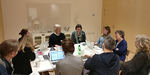
The next morning, SELTA members and the authors descended on the Swedish Embassy in London for an intensive day of discussions and talks about writing and translation. First we heard presentations by Elin Olofsson and Therése Söderlind about their novels. Sweden’s rural north figures prominently in the works of both writers. Elin spoke powerfully about the inspiration she derives from the experiences of her own mother and other strong women in her family tree – her foremothers. Therése outlined the in-depth research she did to uncover the true events that led to over 70 people being put to death for witchcraft in the late 17th century. This story forms the core of her second novel, a review of which is available online.

We then split into two groups to analyse and discuss a bundle of translations that participants had prepared of a brief extract from Elin and Therése’s most recent novels. Looking at multiple English versions of a single source text highlights the differences between individual translators’ interpretations and word choices. It also gives us translators a chance to really geek out about fine shades of meaning and to expand our range of translation strategies, learning from the solutions chosen by our colleagues. Elin Olofsson has shared her own reflections on her group’s workshop discussion in a guest post.
The afternoon session began with presentations by Göran Bergengren and Jonas Gren about their work. Göran’s most recent books contain personal, lyrical essays about birds, butterflies and other elements of the natural world, but he has also written many children’s books. He read some brief extracts and commented movingly about the environmental changes he has observed over the years in his role as a naturalist. Jonas treated us to readings of some of his poems, which added a new dimension to our enjoyment of them. In addition to his creative output as a poet, Jonas is on the editorial team at Effekt, a Swedish magazine that focuses on climate and environmental issues. He does more than just talk the talk: having taken the decision to stop flying, Jonas travelled all the way from Stockholm to London by train for this seminar. Göran and Jonas’ presentations were followed by small-group workshop sessions in which we compared participants’ brief translated extracts that had been prepared in advance.

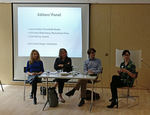
Then it was time to listen to a panel of UK editors who shared their experiences of publishing nature-related books in translation and what they look for in a book when commissioning. Saskia Vogel of SELTA moderated the panel discussion with Laura Barber of Portobello Books, Katharina Bielenberg of MacLehose Press and Luke Neima of Granta Online.


The day concluded with a reception at the Swedish embassy for specially invited publishers and others involved in the UK’s literary scene to chat with the authors and translators over a glass of wine.

The Spring 2018 issue of Swedish Book Review, a literary journal with close ties to SELTA, will feature translated excerpts from these four authors’ works. Let’s hope some enterprising UK publishers will soon snap up their intriguing books and make them available in full to English-speaking readers!

If you’d like to learn more about these four fascinating authors’ works – plus a few more titles from Swedish and Finland-Swedish authors – you can download this PDF brochure.

SELTA is grateful to the Swedish Arts Council and the Anglo-Swedish Literary Foundation for the grants that made it possible to bring the authors over to the UK, to the Embassy of Sweden in London for the use of the seminar venue and staff assistance, and to the Free Word Centre for hosting the public event. My thanks go to Saskia Vogel and Nichola Smalley for their assistance in planning these events and to all the participating authors and translators for contributing to such a thought-provoking and rewarding experience.

By Ruth Urbom

Photo credit: Ian Giles

A Riveting Reviews Workshop

SELTA members Sarah Death, Fiona Graham and Kate Lambert attended the European Literature Network’s workshop on review writing in February 2017.

On 1 February SELTA members attended a workshop on writing book reviews, especially reviews of fiction in translation, run by Rosie Goldsmith of the European Literature Network. The event brought in an impressive range of reviewers, critics and editors to share their reviewing experience and opinions with an audience of aspiring reviewers, translators included. Here Sarah Death, Fiona Graham and Kate Lambert give their thoughts on three and a half hours listening to, sometimes contradictory, words of wisdom from the experts.

Sarah Death:

This non-stop three-and-a-half-hour sequence of engaging speakers left us with heads in a whirl and checklists coming out of our ears, but it was packed with good practical advice. One of my overriding impressions was of the goodwill shown to the European Literature Network and its energetic founder Rosie Goldsmith by all these translator-friendly movers and shakers in the literary media, who gave their services without charge, making this a free event for participants. Speakers included seasoned reviewers, writers and publishers, some wearing multiple hats, and they were generous with their top tips.

Read the whole book (not everyone does), and allow it to settle in your mind before starting to write. A strong personal response and going with your gut instinct is a good thing, but avoid being over-emotional, or your review will say more about you than about the book. By all means be witty and funny, but also take your job seriously and do your homework. Try to make your review a narrative, with a beginning, middle and an end. Arifa Akbar said the best reviews were rather like telling someone in the pub what happened in a book, in two sentences.

The reviewer should attempt to establish her authority, but she can achieve this in far better ways than the clever comparisons with other authors in which some reviewers indulge. (In this, a review of course differs from a reader’s report for a publisher.)  In terms of reviewing translations, the perennial question arose of whether someone who does not speak the source language can judge the translation. Even if they do not, as is usually the case, it is possible and desirable to make informed comment. Boyd Tonkin took the view that while translators of, say, genre fiction might be happy to be self-effacing, the majority of translators hoped to feature in the review and not just be skimmed over with a ‘deftly translated by X’. He felt that with experience, the reviewer develops an instinct for the strategy a translator has developed and employed.

He also answered the question I raised in an earlier blog on the SELTA site, namely whether a publication like SBR could be expected to avoid spoilers altogether. He agreed that we can, and should, allow ourselves these, because we are largely reviewing as-yet-untranslated books, whose endings the average Anglophone publisher cannot know unless we tell them.

The discussion kept coming back to the vexed question of the negative review, especially in a small circle where it will be easy to ruffle feathers. The majority view was that we cannot always run away from writing negative reviews, but there is no excuse for hatchet jobs. One can write a rounded review which acknowledges a book’s good points while also pointing out what one perceives as its flaws. Alexandra Masters from the online magazine BookSmoke reminded us of a wonderful quotation from Kurt Vonnegut:

‘As for literary criticism in general: I have long felt that any reviewer who expresses rage and loathing for a novel or a play or a poem is preposterous. He or she is like a person who has put on full armor and attacked a hot fudge sundae or a banana split.’

A reputation for honest reviews – such as that we have sought to build up in SBR – helps to give a publication and its reviewers credibility. It was heartening if surprising to hear that statistics apparently show a shockingly bad review has just the same effect on book sales as an effusively good one: the public is drawn to both equally. The real trick is to become adept at writing all those in between, or what Claire Armitstead referred to as ‘the three-star area of reviewing’.

********

Fiona Graham:

‘Critics and reviewers are like vultures – not popular, but essential to the ecology,’ according to Claire Armitstead, head of book reviews at the Guardian. If that unflattering description applies to book reviewers in general, what can one say of translators who review the work of their peers, literature in translation? To extend the zoological metaphors, are they not doomed either to play the piranha in the proverbial duckpond if critical, or, conversely, to engage in the mutual grooming typical of gibbons if they praise the work of a colleague?

The European Literature Network’s February workshop on reviewing translated literature helped allay some of these fears. A recurrent theme in the top tips shared by an impressive array of professional reviewers and writers was the reviewer as ‘book appreciator’, to quote Alexandra Masters, founding editor of BookSmoke. ‘Reader-to-reader generosity’, she said, was the key to good reviewing. While several speakers acknowledged the facile entertainment value of slating a book, all stressed the superior skill that writing a measured critical appreciation involves.

Is there a big difference between reviewing a work in the original language and one in translation? Several speakers said this depended largely on the genre. Boyd Tonkin, Senior Writer at the Independent, suggested that reviewers of crime fiction in translation would probably pay less attention to the translation aspect. This view was echoed by Max Easterman, a regular reviewer of crime writing at the European Literature Network’s Riveting Reviews. On the other hand, Max stressed the importance of getting the language exactly right in this often underestimated genre. The writer – like the translator and the reviewer – needs to understand the milieu, including authentic terminology and slang, to ‘make the story come alive’.

When reviewing more traditionally literary fiction, the reviewer may decide to pay greater attention to the translator’s role. Sadly, few are able to compare the translation with the original – and even if they were, the business model for reviewing allows them neither the time nor the money to do so. However, skilled reviewers develop an intuitive ability to ask pertinent questions about the quality of a translation, and may call on friends with the relevant linguistic knowledge to investigate their hunches.

Translators who review books from their own areas of linguistic expertise are, of course, equipped to make informed judgments. However, Boyd Tonkin counselled against devoting too much of the review to the translation itself. Most Anglophone readers, after all, are interested in a book as an English text, not in the process of transformation. Samantha Schnee of Words Without Borders went even further in warning reviewers not to ‘show off’ their knowledge of the original and to avoid nitpicking.

So one message that came across clearly was that a translator reviewing a translated work of literature engages with it primarily as an English text. And in producing a critical appreciation, the translator should be bold and original. A good reviewer will have read and collected plenty of reviews and analysed what makes for success. However, it is probably advisable not to read a lot of reviews of the particular book you are going to write about, according to Arifa Akbar of Wasafiri. Reviewers need to develop their own individual voice and should not be afraid to depart from the consensus or to be ‘unfashionable’. As regards the form the review takes, writing is no longer the only option. The European Literature Network has recently been publishing video reviews – a new and exciting way to engage with a potential readership.

‘The anguish of writing reviews never lessens,’ according to Arifa Akbar. Moreover, reviewing can be very labour-intensive. (Rosie Goldsmith, ELN founder, spent a week on her first review, a 600-word write-up of Hotel du Lac). But for those of us who are keen to build cultural bridges between the Anglosphere and the rest of the world, this is another way to do so which may enrich our work as translators.

*******

Kate Lambert:

It says something for the impressive line-up of speakers taking it in turns at the microphone that the audience sat still for three and a half hours. The speakers were informative and entertaining, just as they told us reviews should be. Claire Armistead, books editor of The Guardian, quoted Stanley Fish in describing the informative aspect, in that reviewers should assume that their readers are ‘intelligent, interested and ignorant’. Meike Ziervogel of Peirene Press, giving a publisher’s view of reviews, said that reviewers need to be sincere readers, even if the publisher or the author would disagree with their view, and advised that reviews need a storyline of their own. Lucy Lethbridge recommended selecting three separate quotes to launch three paragraphs, and picking out quotes while reading rather than afterwards. ‘Read the book!’ was another piece of advice that should go without saying, though apparently not always followed, but ‘let the book settle before writing a review’ was a useful warning to the last-minute adrenaline deadline merchants amongst us.

I was interested to see how much the advice of professional reviewers, with a slant towards books in translation, would apply to reviews written of books in the original language, often with a view to encouraging their translation but there was plenty of practical advice for us all. Swedish Book Review tends not to go in for what Boyd Tonkin referred to as ‘male oedipal gladiatorial butchery’ in the style of early Martin Amis, however, entertaining though this might be. One question asked was whether reviewers change their voice for different publications. Boyd’s response was that reviewers might use different vocabulary but that it was essential not to disguise yourself, to honestly reflect what you think and not to use a voice that is not yours.

A big thank you goes to Rosie Goldsmith and the European Literature Network for putting on the event, and to all the speakers for sharing their tips and especially for being amusing about their own initial forays into the careers in which they are now prominent, which ranged from dogged and determined to cheerfully clueless. There is hope for us all.

Book Bloggers Panel with SELTA

Chair of SELTA, Ruth Urbom, gives an account of the book bloggers’ panel who spoke to our members after SELTA’s 2016 AGM.

On 1 November SELTA members were joined by a panel of three book bloggers who spoke to us about world literature, blogging and the unexpected benefits of sharing their interest in books with other readers. All three of our guest speakers – Ann Morgan, Stu Allen and Bookwitch – have a strong international dimension to their blogs.

The blogger known as Bookwitch, who originally hails from Sweden but has lived in the UK for quite some time now, posts in English as well as Swedish on books for children and young adults. Of books that have been translated from English into Swedish or vice versa, Bookwitch prefers some in Swedish and others in their English version, because the two versions can have slightly different voices and tones. She especially enjoys meeting and interviewing authors for both of her book blogs: a few days before her visit to SELTA, she had conducted an in-depth interview with the popular German author Cornelia Funke. There have been occasions when young readers have found an interview with a favourite author on her blog and mistakenly thought Bookwitch was actually that author herself!

Stu Allen’s blog has a clear focus on the literary end of the spectrum. Stu has been blogging about his interest in world literature for the past eight years and has built up an impressive record of over 600 reviews on his site. He enjoys identifying common themes and features among books from different places. For example, villages often have similar casts of characters no matter where they’re located in the world – you can recognise certain familiar types. Stu is active on social media as well. He originated the #translationthurs hashtag on Twitter, which helps users connect with others who share an interest in reading international fiction. Stu is enthusiastic about helping people to discover world literature and says you can find all kinds of ways in, such as books that feature a particular sport or are set in an interesting location.

When she realised she had read mainly books from the Anglophone world in the year preceding the London Olympics, Ann Morgan set herself a new challenge to read a book from every country in the world in a single year. She named her project A Year of Reading the World and by the time the year was over, her endeavour had taken on some exciting and unexpected dimensions. People from all over the globe got in touch to make suggestions, and Ann received a publishing deal to write up her experiences as a book of her own. Some countries’ writing proved difficult to obtain in English translation, but translators and readers pitched in to contribute stories for Ann to read and review on her blog. Even now, nearly five years after she launched the project, people continue to discover her blog and suggest their favourite books. Ann says there is clearly an interest and an appetite for books from around the world. People are generous and excited about sharing stories.

In the Q&A period following the panellists’ presentations of their blogging activities, SELTA members wanted to know what they do with all the books. All three bloggers said they’re regularly offered free books from publishers’ publicity departments and have to turn some down. Local libraries and charity shops receive some of the volumes after they’ve been read. Bookwitch sizes up children of her acquaintance in order to match young readers with age-appropriate titles. The panellists also asked us about our work as translators. SELTA members’ opinions were divided on whether it’s necessary to read a book all the way through before starting to translate it: one camp says it’s impossible to understand the text sufficiently without reading it first; according to the other school of thought, that’s what the second draft is for.

On behalf of SELTA, I’d like to thank all three of our guest speakers for travelling into London just to speak to us and for giving us some really interesting thoughts from their perspectives as readers and book bloggers.

SELTA

The Swedish-English Literary Translators’ Association
All website content copyright © 2026 SELTA
Login - Privacy Notice - Contact